

Ikea’s Crocker Park Lease Shows How Starved Cleveland Retail Has Become for Space
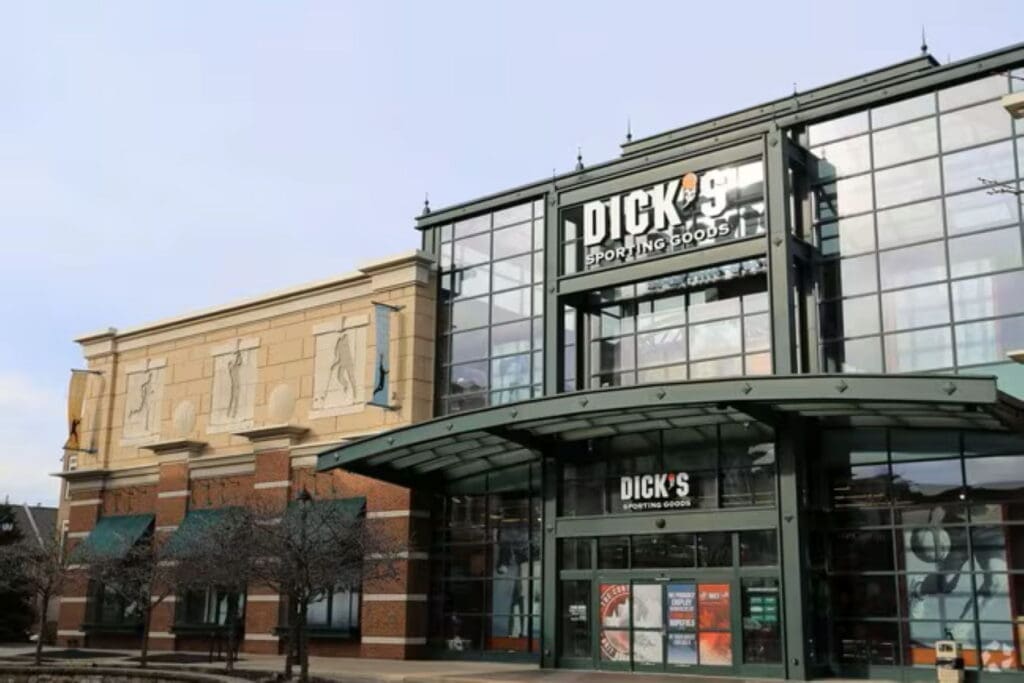
Ikea has signed an 80,000-square-foot lease at Crocker Park in Westlake, backfilling the former Dick’s Sporting Goods box and giving Greater Cleveland — until now the largest U.S. metro without an Ikea — its first store in the region. The small-format location, developed with Stark Enterprises, is slated to open in spring 2027. It’s a genuine win for a top-performing mixed-use center and for shoppers who’ve been driving to Pittsburgh or Columbus for years.
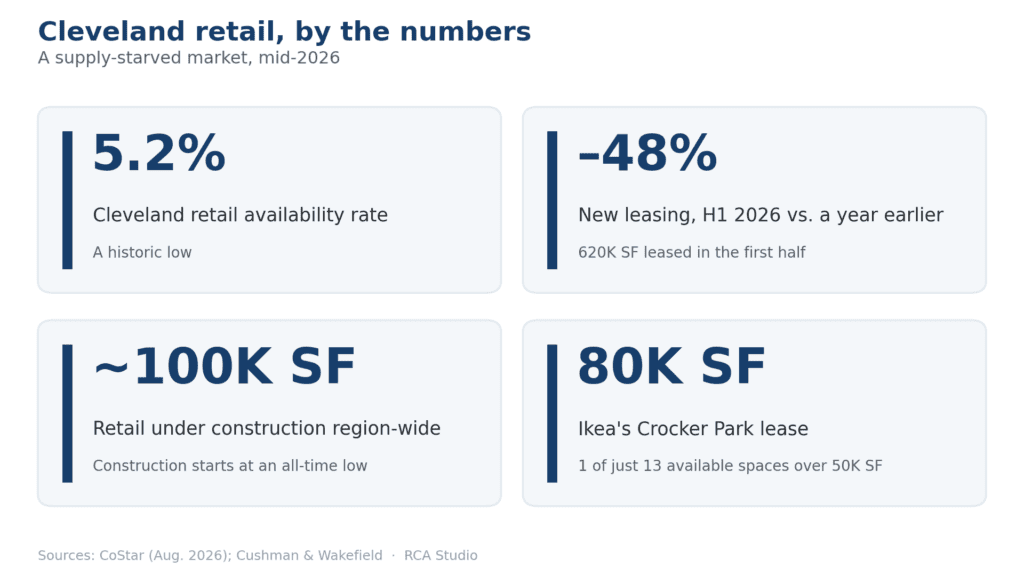
For anyone valuing retail here, though, the more useful signal isn’t the tenant. It’s what the deal reveals about how little space is left. Ikea’s future home was one of only 13 available spaces in the market larger than 50,000 square feet, and one of the few with both a desirable location and a workable layout. A national retailer with a big-format requirement essentially had a baker’s dozen of options in a metro of two million people.
Cleveland retail, mid-2026: low availability, minimal construction, and a rare big-box backfill. Sources: CoStar (Aug. 2026); Cushman & Wakefield.
Low availability, but read why
CoStar puts Cleveland’s retail availability rate at 5.2%, a historic low. That number is real, but the reason behind it matters for how you underwrite it. This isn’t a market where surging demand has soaked up space. It’s a market where almost nothing new is being built.
Only about 100,000 square feet of retail is under construction across the region, with speculative projects accounting for less than a quarter of that. Construction starts over the past year fell to an all-time low. The economics explain it: elevated construction costs and interest rates, against market rents that often can’t justify a new ground-up project. With no new supply, the primary source of available space has become boxes vacated by departing tenants — exactly what Ikea is taking at Crocker Park. A low vacancy rate built on a frozen pipeline is a different animal than one built on booming demand, and it deserves different assumptions.
Leasing has cooled — and both readings are worth holding
New leasing totaled 620,000 square feet in the first half of 2026, down 48% from a year earlier. On its face that looks like weakening demand. But when quality space is this scarce, deals can’t happen simply because there’s little to lease — some of that decline is starvation, not disinterest.
The outside data supports a mixed read. Marcus & Millichap projects Cleveland retail vacancy to keep declining even with slow inventory growth, and expects net absorption to stay positive but below its 10-year average. The demand side has real tailwinds — local incomes are growing above 4%, among the faster paces nationally — and real headwinds, including a projected 0.4% population decline from out-migration and ongoing trade uncertainty. Rather than force a verdict, it’s fair to say the slowdown in leasing is part scarcity and part caution, and let the next few quarters sort out the mix.
What it means for value
The clearest implication is a widening spread between the haves and have-nots. Well-located, functional retail — the Crocker Parks of the market — holds strong pricing power, short downtime, and reliable backfill demand when a tenant does leave. That supports rents, occupancy, and value, and because new construction can’t pencil, quality existing centers effectively trade below replacement cost, which puts a floor under them.
The remaining big-format availability, by contrast, is mostly older freestanding properties — the spaces still on the market precisely because they’re less desirable. Those carry functional and locational obsolescence risk, and the value gap between a trophy backfill and a tired freestanding box is getting wider, not narrower. The Ikea deal is a reminder that adaptive reuse of a vacated box is very achievable when the real estate is good, and much harder when it isn’t.
A word of caution on the income approach: a 5.2% availability rate can tempt aggressive rent-growth and absorption assumptions. The demographic backdrop argues for restraint. Tight supply supports rents; it doesn’t manufacture new demand.
The national mirror
None of this is unique to Cleveland. Nationally, retail vacancy sits at 6.0% — well under the 7.4% long-run average — with asking rents up 2.2% year over year and a construction pipeline under 0.3% of existing inventory. Cushman & Wakefield frames it plainly: structural supply constraints are sustaining rent growth, and vacated space is the opening for expanding retailers. Cleveland’s 5.2% availability is tighter still than that national vacancy figure.
Ikea’s own strategy is the tenant-side version of the same story. The company is opening roughly ten U.S. stores in 2026 and leaning on small-format locations of 50,000 to 100,000 square feet — a fraction of its traditional 200,000-to-500,000-square-foot warehouses — precisely so it can move into existing boxes in supply-constrained trade areas instead of building from the ground up. Westlake is a textbook case: a retailer that wanted in, a market with no new space, and a good vacated box that made it work.
For appraisers and lenders, the takeaway is to look past the headline vacancy rate. In Cleveland retail right now, low availability reflects a frozen supply pipeline at least as much as underlying strength — and the value is concentrated in the well-located, functional space that everyone is competing to backfill.
Sources
- Veronica Miniello, “Cleveland retail availability tightens after Ikea lands at Crocker Park,” CoStar, August 3, 2026
- “Next-gen IKEA store coming to Greater Cleveland,” NEOtrans, July 28, 2026
- “IKEA plots 10 new stores for 2026 — here’s where,” Chain Store Age, 2026
- Marcus & Millichap, “Cleveland 2026 Retail Investment Forecast,” 2026
- Cushman & Wakefield, “U.S. Retail MarketBeat, Q2 2026”
Disclaimer
This article is general market commentary prepared by Rubber City Appraisal Studio, LLC for informational purposes only. It is not an appraisal, valuation, or appraisal review of any property and does not comply with, and is not intended to comply with, the Uniform Standards of Professional Appraisal Practice (USPAP). Nothing here is an opinion of value for any specific asset, nor is it financial, investment, lending, legal, tax, or accounting advice. Readers should not act, or refrain from acting, on the basis of this content and should obtain professional advice specific to their circumstances before making any decision.
The analysis relies on third-party data — including CoStar, Cushman & Wakefield, Marcus & Millichap, and published news reporting — that we believe to be reliable but have not independently verified and do not guarantee for accuracy or completeness. All figures, observations, and opinions are current only as of the date of publication; market conditions change, and we assume no obligation to update. Generative AI tools were used to assist with data synthesis and drafting; all content was reviewed and edited by a Rubber City Appraisal Studio appraiser prior to publication.
This article does not create an appraiser-client or any other professional relationship. To engage a USPAP-compliant appraisal of a specific property, contact us directly.